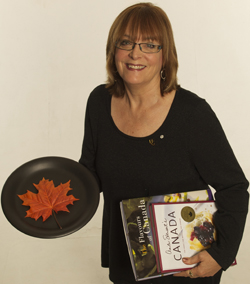
| “It was pretty wild,” explains Stewart. “We had no money! So again, I was called upon to use those skill sets, and I took it as a challenge. I really liked it. It was one of the happiest times of my life. It was really interesting – I learned to do things like render lard.” Stewart’s first cookbook involvement was born from charity rather than necessity, as she and some other mothers got together to raise money for a local pre-school. The Juice and Cookies Cookbook was a cooperative project where home recipes were hand-written on 8.5 x 11 paper, folded, cut and sold for $5. The first “print run” earned enough funding to purchase the appropriate printing equipment, and then the professional version of the book was created. Today, the Elora Cooperative Preschool still stands and thrives, as do many of the friendships created while crafting the book. In the early 1980s, Stewart saw an advertisement in a community newspaper for a food culture course at the University of Guelph. There, her teacher made a game-changing connection with her star student, planting the seeds of a tremendous publishing career. Puts experience to work“I saw the ad, and I thought, holy crow, someone is actually teaching this stuff? So I took the course. The professor, Jo-Marie Powers, said she had an idea for a cookbook and asked if I would like to work on it with her,” says Stewart. “I had no idea how to write a book proposal, but five publishers wanted it. That was the Farmers’ Market Cookbook. And then from that, it became obvious to me that people were doing local food at different levels, so I wondered about country inns. I went on to do The Country Inns Cookbook and The Guide to Canadian Country Inns. I then did The Lighthouse Cookbook – all the time embroidering my knowledge with the real farmers of Canada. There were so many great moments, and it was so exciting.” Researching The Lighthouse Cookbook was one of Stewart’s fondest memories of her travels, crossing Vancouver Island in two icebreaker ships and visiting all of the non-automated life stations on the west coast of North America. The unique lifestyles, stories and above-all gourmet creations of these inhabitants who used gardened and wild vegetables, berries – and of course seafood – were an inspiration. Iconic careerStewart’s involvement at the University of Guelph continues, as she is now their first and only Food Laureate. She is responsible for refining the food inventory, developing events and awareness campaigns, and strengthening connections between local food producers and consumers. She has also been awarded a Doctor of Laws (Honoris Causa), a Master of Arts (Gastronomy) and is honourary lifetime member of the Canadian Culinary Federation of Chefs and Cooks. Referring to her Order of Canada membership as “breathtaking,” Stewart is now working to harness this momentum to further her goals of promoting Canadian cuisine to home kitchens – and to restaurants as well. “I think there’s a lot of room for positive communication. I don’t think we need to bring in chefs from other countries. It’s always nice to be inspired, as Canadians, and maybe learning new things. But in terms of the quality of the production that we have here in Canada, we have some of the finest restaurants here on earth,” says Stewart. Proud Canadian rootsAsked if she has a message for the restaurant industry, Stewart’s passion for the culinary art hearkens back to that little girl at the produce stand. “I think that the link between the restaurant community and agriculture is one that has been talked about, but it’s on the periphery,” says Stewart. “Farmers don’t grow commodities; they grow ingredients so that cooks can create civilization. I think that we as Canadians don’t realize that over 90 per cent of our farms are family owned and operated across the country. It’s pretty amazing. We’re also feeding a great number of people around the world; we’re the sixth largest exporter of food on the planet. There are so many ingredients, like Yukon Gold potatoes and lentils, that have been developed and bred here in Canada that have made an enormous impact on the way the world eats and the way Canadians eat. That’s one thing I’d like Canadians to understand is that we really do need to protect our farmland, because once it’s gone, it’s gone.” See also:
About the author Steven Chester is the editor and social media community manager for Restaurant Central. His 13-year journalism background includes writing and editing for digital and traditional media. He is an expert in social media, online content and email newsletter development. Follow him on Twitter at @restaurantCRFN. | |