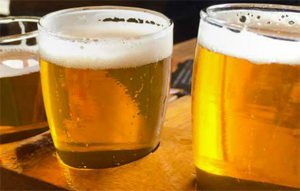
The good news is that this resurgence in beer and in beer knowledge is driving the industry forward, creating new beer and food experiences for the consumer and for the hospitality provider. The fact that beer is lower in alcohol than wine or spirits often makes it more attractive as a beverage of choice when considering responsible use. In addition, the plethora of flavours and aromas that have been created by this new wave of brewing artists is truly encouraging.Drives sales and profitsThe really good news is that this trend of beer exploration is not going away any time soon. People are embracing new hybrid styles of beer and are constantly looking for great beer events and experiences. It really isn’t difficult these days to create a worthwhile beer menu and combine it with a food menu to drive traffic and profitability. However, we can’t be all things to all people. My advice to foodservice operators is to be thoughtful and creative. Thoughtful means that you consider who your guests are, what kind of food items are on your menu, what kind of experience you want to create and how beer can fit into those plans. Beer, while it can sometimes be viewed to be the accessory that finishes an outfit is also a massive contributor to profit and overall sales revenue. What can you do to sustain your growth of beer? Easy! Select your beers (either draught or bottle) carefully. It’s necessary to offer a provocative selection. Different styles appeal to a wider variety of guests and can easily be matched to different menu items. It makes absolutely no sense to offer 10 beers that are all in the same flavour profile. This would be similar to only having 10 types of hot dogs on the menu – good for some but not for most. Consider “one more”In my career, I have acknowledged the simple fact that sales targets are a necessary evil. We have to have goals and aspirations. The problem with objectives in sales is that sometimes the number is so daunting, it becomes a disincentive. Asking your staff to increase sales can be the elephant in the room. A lot of servers and bartenders actually become disengaged when driven to accomplish higher sales targets. A simpler, more effective approach is the concept of “one more.” While maintaining a responsible drinking mindset, just imagine the impact of selling one more beer to each table during a shift. The glory of this concept is in its simplicity. Who can’t sell or even offer one more beer to a table? In reality, this is not up-selling, it’s simply understanding and meeting the needs of our guests. Consider this scenario: You have three servers per shift. Each manages 11 tables during an eight-hour shift and you can expect four turns per shift. This means that we have 132 tables of guests. If we sold one 20 ounce pint to each table at $7.50 per glass, that would mean… - An additional $990 per shift in total sales revenue. Consider that each pint might provide $5 in profit – that equals $660 in profit.
That results in… - $6,930 increase in sales per week
- $29,700 increase per month
- $356,400 per year
The profit increase is… - $4,620 per week
- $19,800 per month
- $237,600 per year!
Not bad numbers for helping your bartenders and servers to sell “one more!” There is also a benefit to the staff member. If you consider that 11 tables will be turning four times a shift, it is possible for each staff member to increase their tips by $50 per shift (44 beers @ $7.50 x 15 per cent) In conclusion, consider the impact of a well-thought-out beer portfolio that showcases a variety of styles and flavours. This can become the cornerstone of a new vibrant sales strategy that drives quality beer experiences while increasing traffic and profitability.
About the author Roger Mittag is the owner of Thirst For Knowledge Inc® and the founder of Prud’homme Beer Certification® and can be reached at [email protected] for a customized beer evaluation program. |