Asian flavours diversify menus

Asian flavours diversify menus

By Laura McGuire
April 2010

It’s no secret that Asian cuisine uses a multitude of ingredients.  A snapshot of the most commonly added ingredients represents a wide range of flavours.

Top ingredients

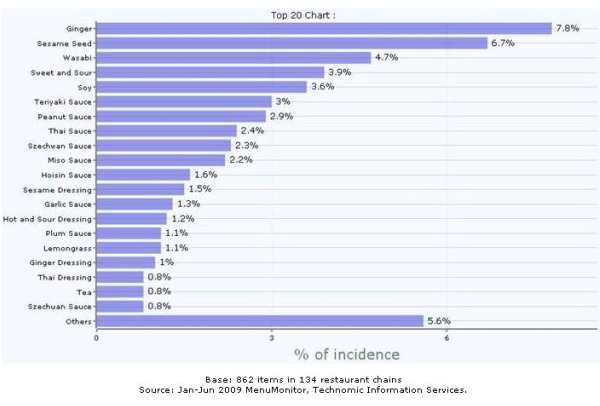
Ginger is undoubtedly the top ingredient in Asian cuisine, listed in about 8% of menu items.  This incidence is not surprising, given the popularity of dishes such as ginger chicken, pork and beef.  Ginger is also part of most types of Asian cooking, including Chinese, Thai and Japanese.

Sesame seeds are the second most common ingredient, with an incidence of almost 7%.  Sesame chicken is a Chinese dish that appeals to Western tastes with its sweet flavour and smooth yet crunchy texture.  Sesame seeds are also often incorporated into Japanese cuisine – for instance, as toppings on sushi maki rolls.

Also known as ‘Japanese horseradish,’ wasabi had the third-highest incidence (5%).  The green, sharply flavoured condiment is integral to Japanese cuisine, frequently accompanying sushi and sashimi, and added to soy sauce.

Rounding out the top five ingredients are sweet-and-sour and soy sauces, both with incidence rates close to 4%.

Ingredients infrequently mentioned on Asian restaurant menus in Canada include Thai dressings, tea and Szechuan sauce.  Each of these items had just a 0.8% incidence.  Interestingly, ginger dressing had a 1% incidence, surprisingly low given ginger’s overall ranking as the top ingredient on Asian menus.


Top flavours

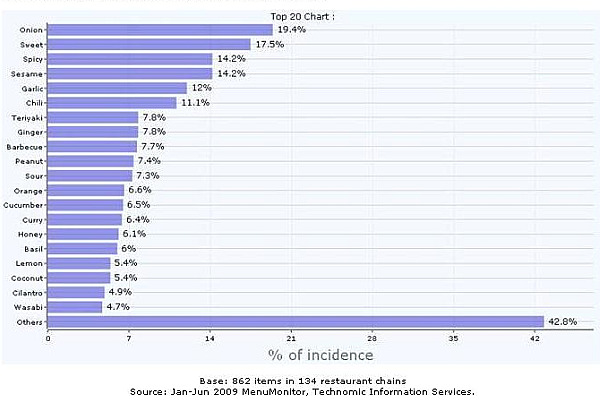
The 20 most popular flavours on Asian restaurant menus are all fairly well-represented, each with an incidence greater than 4%.

Appearing in nearly one-fifth of Asian menu items, onions are by far the most common flavour.  Many Asian cuisines, particularly Japanese, emphasize vegetables (such as onions) and place less importance on meat and poultry.

‘Sweet’ is the second most common flavour description, with an almost 18% incidence.  Dishes like sweet-and-sour pork and chicken are extremely popular with restaurant-goers.

‘Spicy’ and sesame flavours are equally represented at about 14%.  Different Asian cuisines feature a number of spicy foods, such as Korean kimchi and Thai curries.  Other common flavours on menus include garlic and ginger, both generally perceived to have nutrition benefits.

Cilantro, coconut and lemon were some of the least common flavours, although each appeared on roughly 5% of menus.  Operators looking to differentiate their menu offerings might consider fusing these rarer flavours with the more common ones to create flavour hybrids like cilantro-ginger or lemon-sesame.  Such combinations would likely appeal to consumers increasingly demanding bold and innovative flavours.

< Back
Copyright © RestoBiz. All rights reserved.