| Chemical-free cleaning is an outgrowth of green cleaning, which took the professional cleaning industry by storm about a decade ago. And many of the early supporters of green cleaning are now emerging as advocates for chemical-free cleaning as well. Its key proponent is Vince Elliott, author of the book Extreme Green Cleaning. Elliott gave his book this title because the goal of green cleaning chemicals is to reduce cleaning’s impact on the environment. However, when no chemicals are used at all in the cleaning process, this takes it to a higher level—a new extreme, so to speak, essentially eliminating cleaning’s impact on the environment entirely. Elliott says that chemical-free cleaning refers to any product or procedure that leaves no synthetic chemical residue in the air or on a surface after a cleaning task has been performed. Further, he says the cleaning product or procedure “must have no negative health outcome or demean indoor air quality” to be considered a chemical-free cleaning agent. Chemical-free cleaning in practice As you might imagine, many in the professional cleaning industry, especially those involved with cleaning restaurants, question whether using no chemicals at all will be effective and help protect human health, the ultimate goal of all cleaning. (In some facilities, such as healthcare locations, certain chemicals, such as disinfectants and sanitizers, must be used in specific areas of the facility as required by laws and local regulations.) However, even the skeptics agree on some aspects of chemical-free cleaning: - If it is effective and protects human health, then it is the ultimate in green cleaning.
- It can prove to be a cost savings, especially in restaurants, where cleaning chemicals can be a significant expense.
- It can help keep surfaces cleaner. If not thoroughly removed, cleaning chemical residue can act as a magnet, drawing more soils and contaminants to surfaces; when no chemicals are used, this problem is eliminated.
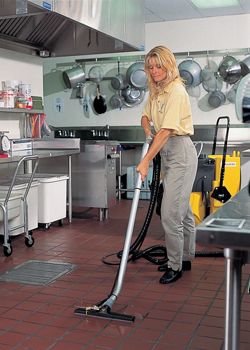
So how can restaurant cleaning workers clean without chemicals? The following are examples of chemical-free cleaning systems and methods that have proved their value in cleaning effectively: - Spray-and-vac (no-touch) cleaning systems. Although these machines were originally developed to be used with chemicals, recent tests by the independent National Environmental Laboratory Accreditation Program (NELAP) using no chemicals and just tap water found that some of these systems removed approximately 99.9 per cent of targeted bacteria on surfaces. Some no-touch systems work by releasing pressurized water onto surfaces, which loosens contaminants that are then vacuumed up and removed.
- Activated and electrolyzed water systems. Although these are not quite identical systems, they both use electrical current applied to water to turn it into a cleaner/disinfectant.
- Vapour and steam cleaning systems. Not to be confused with vapor or steam cleaning systems available at mega-retailers, these professional units are designed to heat water to about 120 C (248 F). They essentially melt away soils and contaminants that evaporate or can be easily wiped away.
The end of cleaning chemicals? Some advocates of chemical-free cleaning expect new technologies and systems in the next few years that will make chemical-free cleaning more common and a key alternative to traditional and even green cleaning. However, others are not as enthusiastic. For instance, Mike Sawchuk, vice president and general manager of Ontario-based Enviro-Solutions, a green chemical manufacturer, believes there will always be a place “and a need for chemicals. While chemical-free cleaning will likely play a more significant role in cleaning in restaurants and other facilities in years to come, some cleaning methods will invariably require the use of chemicals.” As an example, Sawchuk indicates users have found chemical-free cleaning technologies, specifically the activated and electrolyzed water systems, effective in some situations but less effective in others. “The future of chemical-free cleaning is still somewhat uncertain, but the trends we see emerging, first with green cleaning and now with chemical-free cleaning, are more and more cleaning processes and systems that are healthier for the user, building users, and the environment.” See also:
About the author Robert Kravitz is a writer for the professional, healthcare, hospitality, and education industries. He may be reached at [email protected]. | |